
Classic Layered Red Velvet Cake with Cream Cheese Frosting
This classic layered red velvet cake yields 10 to 12 slices and pairs a tender crumb with a thick cream cheese frosting.
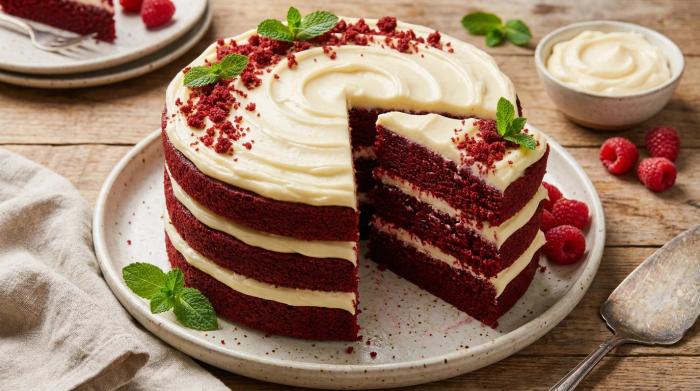
A mild chocolate flavor and a subtle acidic tang define a proper Classic Layered Red Velvet Cake with Cream Cheese Frosting. Butter and oil give the crumb structure and moisture. This recipe yields 10 to 12 slices. The thick frosting balances the tender layers.
The Dry Mix
The Dry Mix requires 2 2/3 cups (400 g) of plain cake flour. Cake flour creates a soft crumb with minimal elasticity. Two tablespoons (10 g) of unsweetened cocoa powder provide the mild chocolate flavor. Baking soda provides the necessary lift. Do not substitute baking powder. Baking soda is significantly stronger. It requires the acidity of buttermilk for activation.
You can modify the flour component if needed:
- All-purpose flour works as a direct replacement, though it yields a slightly firmer cake.
- You can create a substitute by removing 60 grams from 400 grams of all-purpose flour and replacing it with 60 grams of cornstarch.
The Wet Mix
You start the Wet Mix by creaming 1/2 cup (115 g) of softened unsalted butter and 1 1/2 cups (330 g) of superfine white sugar. Superfine sugar blends into the batter more quickly than standard granulated sugar. Standard white sugar acts as a direct substitute if you do not have superfine.
Limit the eggs to two to prevent an overly eggy taste. Beat the batter thoroughly after each addition. The mixture often looks curdled at this stage. Keep the mixer running until the paste turns smooth. Failure to mix well causes the oil to separate and pool at the base of the baked cake.
Pour 1 cup (250 ml) of vegetable oil, 1 teaspoon of white vinegar, 2 teaspoons of vanilla extract, and 1 cup (250 ml) of room-temperature buttermilk into the bowl. Genuine buttermilk is required here, as substituting a mixture of milk and lemon juice negatively affects the texture. Finish the liquid ingredients by blending in 2 1/2 tablespoons of liquid red food coloring. Since liquid dye might fail to deliver a bright red shade, utilizing gel food coloring instead yields a much more intense hue.
Mix the sifted dry ingredients into the wet mixture. Allow the batter to retain small lumps. Do not overmix the dough.
Baking the layers
Measure all ingredients using a single system of weight or volume to maintain accurate ratios. A mid-recipe switch between metric weights and cup measurements causes inaccurate proportions.
Prepare two 8-inch (21 cm) circular baking pans by buttering the bottoms and edges. Dust the greased surfaces with cocoa powder. Divide the batter between your pans. Bake them on a single oven rack at 350°F (180°C) for 25 to 30 minutes. Turn the oven off and rest the cakes in their pans for 10 minutes. Turn each layer out onto a cooling rack and let them cool completely. Cut the domed tops off the baked cakes with a bread knife. The cuts create flat layers for stacking. Crumble the trimmed cake tops to use as a decorative garnish.
Cream Cheese Frosting
The Cream Cheese Frosting requires a 14-ounce (400 g) block of cream cheese. Block cream cheese creates a firmer frosting than spreadable tub varieties. Tub cream cheese can replace block cream cheese if you reduce the starting quantity to maintain stiffness.
The butter and cream cheese must be softened slightly for mixing without becoming excessively warm. Excessively soft butter or cream cheese causes runny frosting. Beat the butter, cream cheese, and 1 1/2 teaspoons of vanilla extract for three minutes until the mixture turns pale and smooth. Add 4 cups (450 g) of sifted powdered sugar in two stages. Beat the icing sugar mixture for two minutes until it becomes airy.
Assembly
Spread 1 1/2 cups of the frosting over the first flat cake layer. Place the second layer directly on top. Scoop the remaining frosting onto the stacked dessert and spread it across the upper surface and exterior. Press the crumbled red trimmings around the edges of the frosted dessert.
You might encounter runny frosting if your kitchen is warm. Refrigerate runny frosting for 15 to 30 minutes before beating it again to restore its structure.
Classic Layered Red Velvet Cake with Cream Cheese Frosting
Dry Mix
- 2.67 cup plain cake flour
- 2 tbsp unsweetened cocoa powder
- 1 tsp baking soda, not baking powder
- Pinch of salt
Wet Mix
- 2 room-temperature eggs, about 2 oz (60 g) each
- 1.5 cup superfine white sugar
- 0.5 cup unsalted butter, softened
- 1 cup vegetable oil
- 1 tsp white vinegar
- 1 cup room-temperature buttermilk
- 2.5 tbsp liquid red food coloring
- 2 tsp vanilla extract
Cream Cheese Frosting
- 4 cup sifted powdered sugar
- 14 oz block cream cheese, slightly softened
- 0.5 cup unsalted butter, slightly softened
- 1.5 tsp vanilla extract
We may earn a small commission from grocery & equipment links, at no cost to you. Disclosure.
Method
Dry Mix
Wet Mix
Cream Cheese Frosting
Assembly
Substitutions
Standard granulated white sugar acts as a direct substitute for the superfine white sugar in the Wet Mix.
All-purpose flour works as a direct replacement for the plain cake flour in the Dry Mix but yields a slightly firmer cake.
Serving
Crumble the trimmed domed cake tops during Assembly to use as a decorative garnish for your Classic Layered Red Velvet Cake with Cream Cheese Frosting.
Common mistakes
Substituting baking powder for the baking soda fails because baking soda is significantly stronger.
Using a mixture of milk and lemon juice instead of real buttermilk in the Wet Mix compromises the texture of the cake.
Allowing the butter or block cream cheese to become excessively soft causes a runny Cream Cheese Frosting.
Switching between metric weights and cup measurements mid-recipe causes inaccurate proportions.
Techniques
Beat the Wet Mix thoroughly after each addition to prevent the vegetable oil from separating and pooling at the base of the baked cake.
Refrigerate runny Cream Cheese Frosting for 15 to 30 minutes before beating it again to restore its structure.
Always let baked cake layers cool completely on a wire rack before spreading icing to prevent it from melting.
Bring cold eggs and dairy to room temperature before mixing to ensure they emulsify smoothly into the batter.
Scrape down the sides and bottom of your mixing bowl frequently to ensure an even incorporation of all ingredients.
Can I use standard all-purpose flour instead of plain cake flour for the Dry Mix?
Yes. All-purpose flour works as a direct replacement, but it yields a slightly firmer cake. To better mimic cake flour, you can create a substitute by removing 60 grams from 400 grams of all-purpose flour and replacing it with 60 grams of cornstarch.
Is it okay to sour my own milk for the Wet Mix instead of buying buttermilk?
No, you must use real buttermilk. Using a homemade mixture of milk and lemon juice compromises the texture of your Classic Layered Red Velvet Cake with Cream Cheese Frosting.
Can I use gel food coloring instead of the liquid color called for in the Wet Mix?
Yes. Gel food coloring often yields a more intense hue than liquid varieties. Liquid food coloring sometimes fails to produce a bright red shade.
Why did oil pool at the bottom of my baked cake layers?
This happens if the Wet Mix is not beaten adequately after each addition. You must keep your mixer running until the paste turns completely smooth to prevent the oil from separating during baking.
How do I fix runny Cream Cheese Frosting?
Runny frosting is usually caused by allowing the butter or block cream cheese to become excessively soft before mixing. To fix it, refrigerate the frosting for 15 to 30 minutes before beating it again to restore its firm structure.
What should I do with the domed tops after I cut them off?
Crumble these trimmings during Assembly to use as a decorative garnish. You can press the crumbs around the edges of your finished Classic Layered Red Velvet Cake with Cream Cheese Frosting.
Can I freeze the baked cake layers ahead of time?
Yes, unfrosted cake layers freeze very well. Wrap each completely cooled layer tightly in plastic wrap and a layer of aluminum foil before storing them in the freezer.
How should I store the leftover cake?
Any dessert topped with dairy-based icing must be kept in the refrigerator. Place it in an airtight container to keep the crumb from drying out, and let slices sit at room temperature briefly before serving.
Why is it important to use room-temperature ingredients?
Cold eggs and dairy do not blend together easily. Bringing them to room temperature ensures they emulsify smoothly into the batter, which helps give the baked cake a lighter texture.
Add a private note
Private to this device - jot your tweaks, swaps and timings. (Syncs to your account later.)
What to serve with it
See all →





You might also like
See all →


The Friday 3-recipe dinner plan 🧡
Every Friday: three tested weeknight dinners + one shopping list, ready to go. No spam, ever - unsubscribe anytime.