
Classic Fluffy Vanilla Cake with Silky Buttercream
You beat the eggs and sugar for a full 7 minutes to lift this Classic Fluffy Vanilla Cake, and hot milk with melted butter keeps the crumb tender.
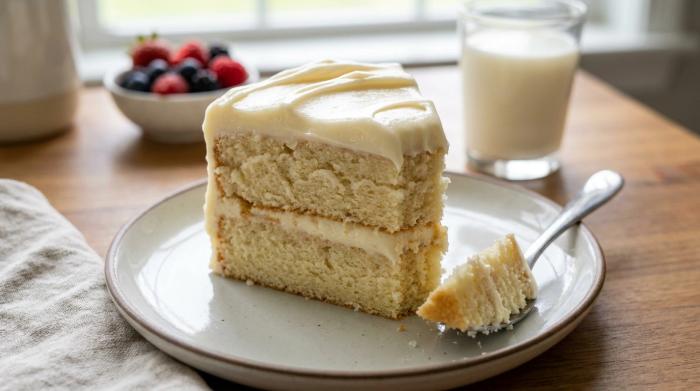
You build the structure for this Everyday Vanilla Cake by beating eggs and sugar for a full seven minutes. You skip creaming the butter entirely. Instead, you fold a heated milk and butter mixture into the aerated eggs to create a tender crumb that bakes at 350°F (180°C). The recipe moves fast once the mixer starts.
Choosing the ingredients
All-purpose flour provides the best texture for this recipe. Cake flour will leave the baked surface sticky and sweaty by the second day.
Superfine sugar dissolves completely while you whip the eggs. You can use granulated sugar instead with minor visual changes. Granulated sugar leaves faint brown flecks across the top but keeps the same texture. Do not reduce the sugar amount. The eggs require the full measure of sugar to form a stable foam.
Fresh, room-temperature eggs hold more air than cold eggs. You can warm cold eggs by soaking them in warm water for five minutes. Rinse your mixing bowl under warm water so cold metal does not chill the eggs. Standard large eggs weigh between 50 and 55 grams each in the shell.
Full-fat milk tenderizes the crumb. Low-fat milk works but causes a slightly lower rise. Plant-based milk creates a tougher cake. A small addition of vegetable oil keeps the cake soft for several days. The batter will weigh down and fail to rise if you add extra oil.
Always check your baking powder. Old baking powder stops the cake from rising. You can substitute three-quarters of a teaspoon of baking soda for the baking powder, but the cake will bake with less volume. Imitation vanilla serves as an exact replacement for pure vanilla extract.
The Cake Batter
The process starts by whipping the eggs and sugar.
You need to run the mixer for a full seven minutes until the mixture turns white and triples in size.
Do not pause the mixer halfway through. The trapped air bubbles will deflate if you stop the motor.
You microwave the milk and butter until the butter melts.
You must keep this Hot Milk Mixture hot. The final cake turns out dense if you let the liquids cool before mixing.
You fold the flour into the whipped eggs next.
Stop mixing as soon as the flour disappears. You will press the air back out of the eggs if you overmix the batter.
The Hot Milk Mixture
You cannot pour the hot liquids straight into the aerated eggs. You must temper the liquids first. You scoop a small amount of Cake Batter into the hot milk and whisk them together.
This step equalizes the temperatures and lightens the heavy liquid. Once tempered, you pour the milk mixture back into the main bowl.
Run the mixer on its lowest speed just until the batter looks smooth.
Baking & Cooling
Preheat your oven thirty minutes before you plan to bake. This prevents the temperature from dropping when you open the oven door. Use solid cake pans for this batter. Springform or loose-bottom pans will leak.
Pour the batter into two greased and lined pans.
Lift each pan and drop it onto the counter three times.
This action forces large trapped air bubbles to break at the surface. Bake the cakes until the tops turn golden.
Turn the cakes out onto a wire rack. Cool them upside down. This flattens the domed tops and makes layering easier.
Buttercream Frosting
The frosting requires softened butter. You beat the butter on high for three minutes until it loses its yellow color and looks nearly white. You add powdered sugar in stages. A splash of milk adjusts the consistency if the mixture feels too stiff.
Serving options
You can serve the cake in a few ways:
- Cover the layers in Buttercream Frosting.
- Coat the top in a chocolate glaze.
- Layer the inside with jam and whipped cream.
- Dust the bare cake with powdered sugar and serve it alongside fresh berries.
Leftovers
The baked cake retains its moisture and soft texture for up to four days at room temperature.
Classic Fluffy Vanilla Cake with Silky Buttercream
Vanilla Cake Batter
- 4 large eggs, 2 oz (50 to 55 g) each, at room temperature
- 2 cup all-purpose flour
- 2.5 tsp baking powder
- 1.5 cup superfine sugar
- 0.5 cup unsalted butter, cut into 0.5-inch (1.5 cm) cubes
- 1 cup full-fat milk
- 3 tsp vegetable oil
- 0.25 tsp cooking salt
- 3 tsp vanilla extract
Buttercream Frosting
- 1 lb powdered sugar, sifted
- 2 stick unsalted butter, softened
- 2 tbsp milk
- 3 tsp vanilla extract
We may earn a small commission from grocery & equipment links, at no cost to you. Disclosure.
Method
Whip the Eggs
Mix the Batter
Bake the Cake
Cool and Decorate
Buttercream Frosting
Cool and Decorate
Substitutions
You can swap granulated sugar for the superfine sugar in the Cake Batter, which works fine but may leave tiny brown flecks on top of your cake.
Low-fat milk is an acceptable substitute for full-fat milk, though the cake will not climb quite as high.
Storage
The baked Everyday Vanilla Cake will maintain its moisture and soft texture for up to four days at room temperature.
Serving
If you prefer to skip the Buttercream Frosting, you can dust the baked cake with powdered sugar and serve it alongside fresh berries and sweet cream.
Common mistakes
Stick to all-purpose flour for the Cake Batter, as using cake flour will create a sticky and sweaty surface on the baked layers by the second day.
Do not allow the Hot Milk Mixture to cool down before combining it with the rest of the ingredients, or the final crumb will turn out excessively dense.
Avoid using springform or loose-bottom pans for Baking & Cooling, as the thin batter will easily leak out of the bottom.
Techniques
You can quickly warm cold eggs by submerging them in warm water for five minutes to improve their aeration capacity.
Cooling the baked cakes upside down on a wire rack naturally flattens their top domes for perfectly even layering.
Dropping the filled cake pans onto the counter three times before baking forces large trapped air bubbles to the surface.
Allowing freshly baked cakes to cool briefly in their pans before turning them out prevents the delicate warm crumb from tearing.
Always scrape the sides and bottom of your mixing bowl with a rubber spatula to ensure all ingredients are fully incorporated into a uniform mixture.
Sifting powdered sugar before beating it into softened butter guarantees a silky smooth frosting free of stubborn lumps.
- Store
- The baked Everyday Vanilla Cake will maintain its moisture and soft texture for up to four days at room temperature.
Can I use cake flour instead of all-purpose flour for the Cake Batter?
Stick to all-purpose flour for this recipe. Using cake flour will leave the baked surface of your Classic Fluffy Vanilla Cake with Silky Buttercream feeling sticky and sweaty by the second day.
Can I reduce the amount of sugar to make the cake less sweet?
Do not reduce the sugar amount. The eggs require the full 1.5 cups of sugar to whip into a stable foam that gives the cake its structure.
Is it okay to use a dairy-free milk alternative?
It is best to avoid plant-based milk because it creates a tougher crumb. If you need a substitute for full-fat milk, low-fat milk is acceptable but will result in a slightly lower rise.
Why did my cake turn out dense and heavy?
This usually happens if the Hot Milk Mixture cools down before you mix it into the aerated eggs. You must keep the liquids hot to ensure they fold in smoothly without deflating the batter.
Can I use a springform pan for Baking & Cooling?
Avoid using springform or loose-bottom pans. The Cake Batter is quite thin and will easily leak out of the bottom of unsealed pans before the heat can set it.
Why do I need to mix a small amount of batter into the hot milk first?
This tempering step equalizes the temperatures and lightens the heavy liquid. If you pour the hot milk straight into the bowl, it will deflate your whipped eggs.
How long does this cake stay fresh?
The baked cake retains its moisture and soft texture for up to four days at room temperature.
What are some alternative ways to serve this if I do not make the Buttercream Frosting?
You can dust the bare cake layers with powdered sugar and serve them alongside fresh berries and sweet cream. It is also delicious coated in a simple chocolate glaze or layered with jam.
Why is it important to let freshly baked cakes rest in their pans before turning them out?
Allowing cakes to cool briefly in the pan gives the delicate crumb time to set. Turning them out while piping hot often causes the structure to tear or break apart.
Can I freeze baked cake layers to assemble later?
Yes, plain baked cake layers freeze exceptionally well. Wrap the completely cooled layers tightly in plastic wrap followed by aluminum foil to protect them from freezer burn.
Why should I sift powdered sugar before making frosting?
Sifting removes hard lumps that naturally form when powdered sugar sits in the pantry. This extra step guarantees a silky smooth frosting that is easy to spread.
Add a private note
Private to this device - jot your tweaks, swaps and timings. (Syncs to your account later.)
What to serve with it
See all →





You might also like
See all →
The Friday 3-recipe dinner plan 🧡
Every Friday: three tested weeknight dinners + one shopping list, ready to go. No spam, ever - unsubscribe anytime.